26 Swiss Cantons: Population, Taxes & Surprising Facts
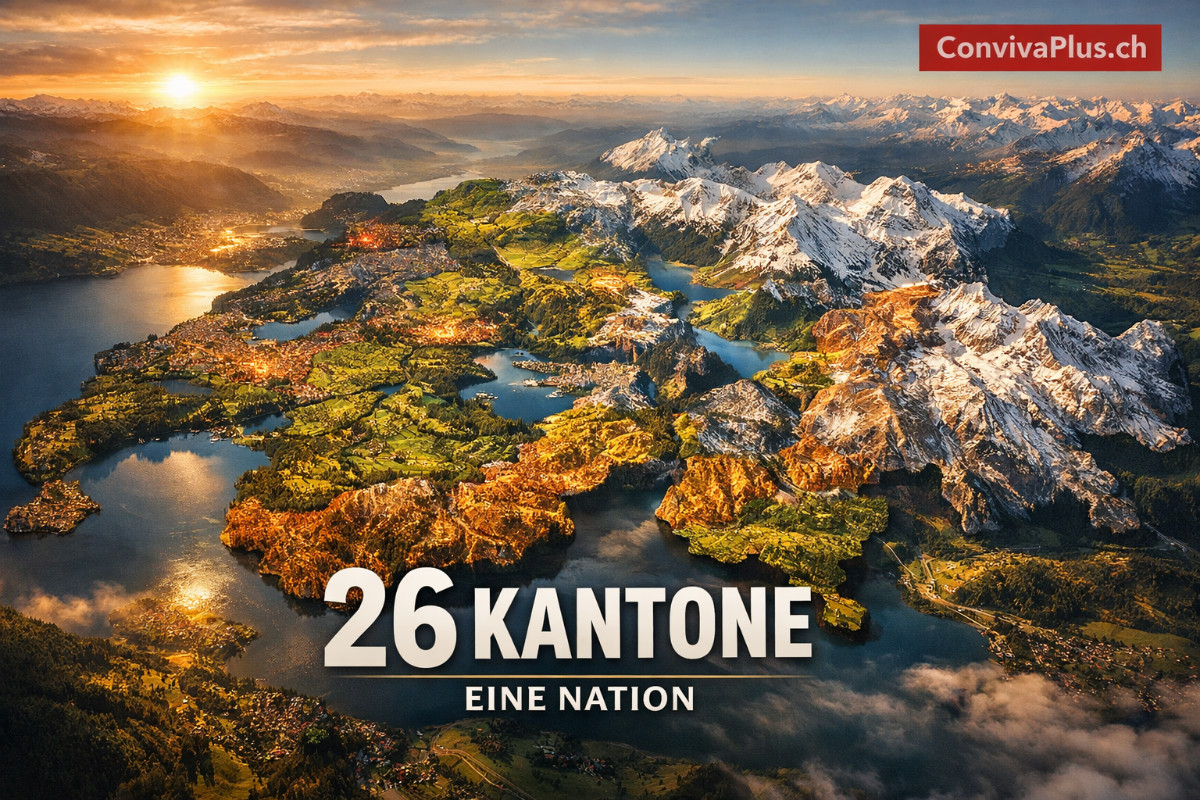
Switzerland has 26 cantons with a total of 9.05 million inhabitants. From tax-friendly Zug to expensive Geneva, from trilingual Graubünden to the canton that has only existed since 1979.

Zurich alone has more inhabitants than the 10 smallest cantons combined. Switzerland is a land of contrasts – and of cantons.
FSO, population statistics 2024
🗺️ 26 Cantons – An Overview
Switzerland is not a centralist state – it is a federation of 26 cantons, each with its own constitution, parliament, courts and tax system. What a federal state does in Germany, the canton does in Switzerland – with significantly more autonomy. Education, healthcare, police, taxes – all regulated at cantonal level.
The differences are enormous: Basel-Stadt at 37 km² is smaller than many municipalities, Graubünden at 7,105 km² is larger than some European countries. Appenzell Innerrhoden has 16,700 inhabitants, Zurich 1.62 million. In Zug you pay half as much tax as in Bern. And in Graubünden they speak three languages – sometimes in the same valley.
🏛️ All 26 Cantons in Detail
Sorted by population – from largest to smallest. Each canton with capital, population, area, language and what makes it unique.

Largest canton by population and the economic engine of Switzerland. Zurich's financial centre alone manages around a third of all Swiss banking assets. Add the ETH, the University, and a start-up scene that competes internationally.

Federal city and de facto capital of Switzerland – legally, Switzerland has no capital. Second-largest canton by area, bilingual (German in the north, French in the Bernese Jura). UNESCO World Heritage Old Town with 6 km of arcades.

The Lavaux vineyard terraces are a UNESCO World Heritage Site – 830 hectares of vineyards on Lake Geneva. Lausanne is home to the Olympic Committee (IOC) and the Federal Supreme Court. Largest entirely French-speaking canton.

The «Rüeblikanton» (carrot canton) – a nickname from its carrot cake tradition. Home to three of Switzerland's four nuclear power plant sites: Beznau (I+II, Döttingen) and Leibstadt. Only Gösgen is in Solothurn. Transport hub between Zurich, Basel and Bern.

The Abbey Library is a UNESCO World Heritage Site and one of the oldest libraries in the world (founded in the 8th century). Historical textile tradition: St. Gallen lace was once world-famous. Today a university city with a strong economy.

Seat of the UN (European headquarters), the Red Cross, the WHO, CERN, and over 30 other international organisations. The Jet d'eau shoots 140 metres high. Smallest canton in western Switzerland, but by far the most international.

The Chapel Bridge (built in 1333, reconstructed after the 1993 fire) is the oldest covered wooden bridge in Europe and THE Swiss postcard motif. Tourism magnet on Lake Lucerne. Mount Pilatus and Rigi right on the doorstep.

The only entirely Italian-speaking canton – Mediterranean Switzerland with palm trees, risotto and piazzas. The three castles of Bellinzona are a UNESCO World Heritage Site. Locarno has the warmest climate in Switzerland and its famous film festival.

45 peaks over 4,000 metres, more than 300 days of sunshine a year, and home of the Matterhorn. Bilingual: French in the Lower Valais, German in the Upper Valais. Raclette and Fendant (Chasselas wine) are Valais national treasures.

Bilingual canton on the language border – the city of Fribourg itself is bilingual. Home of Gruyère AOP, the world's most famous Swiss cheese. The University of Fribourg is Switzerland's only bilingual university.

The «other Basel» – split from Basel-Stadt in 1833 after a civil war. Part of the pharma region (Novartis, Roche have sites in both half-cantons). Known for cherry tarts and the Chienbäse parade in Liestal.

Lake Constance canton, nicknamed «Mostindien» (cider India) for its cider-making tradition. One of the most agriculturally productive cantons. Napoleon granted Thurgau independence in 1798 – before that, it was a subject territory.

The «most beautiful baroque city in Switzerland» – and the number 11 is sacred: 11 churches, 11 fountains, 11 towers. As seat of the French ambassadors (16th-18th century), Solothurn earned the nickname «City of Ambassadors». The Verena Gorge is a hidden gem.

Largest canton in Switzerland by area – and the only trilingual one (German, Romansh, Italian). 150 valleys, 615 lakes, and the Rhaetian Railway (UNESCO World Heritage). Chur is Switzerland's oldest city (over 5,000 years of settlement history).

Smallest canton by area (37 km²), but the most densely populated: over 5,000 people per km². Pharma capital of the world (Novartis, Roche). The Basel Carnival is a UNESCO Intangible Cultural Heritage (since 2017) – three days of controlled chaos.

Heart of the Swiss watchmaking industry – Le Locle and La Chaux-de-Fonds are UNESCO World Heritage watchmaking cities. This is where absinthe was invented (Val-de-Travers). And where the CEH developed the first Swiss quartz watch in 1967.

Gave its name to all of Switzerland – «Schwyz» became synonymous with the Confederation. The Federal Charter Museum houses the Federal Charter of 1291 (founding document). Tax-friendly: Wollerau and Freienbach are among Switzerland's lowest-taxed municipalities.

Tax haven No. 1 in Switzerland – combined tax rate of only about 13%. Crypto Valley: over 1,000 blockchain companies are based here. Also a commodity trading hub: Glencore and other trading giants reside on Lake Zug.

The Rhine Falls at Neuhausen, 150 metres wide and 23 metres high, are Europe's largest waterfall by volume. Schaffhausen's old town has over 170 oriel windows – more per capita than any other Swiss city. The only canton north of the Rhine.

Switzerland's youngest canton – only split from Bern in 1979 after decades of conflict, sometimes violent. The name comes from the Jura mountains. Affordable housing, but one of the highest tax rates. Horse breeding (Franches-Montagnes) has a long tradition.

No official capital – the government seat is in Herisau, the cantonal court in Trogen. Separated from Appenzell Innerrhoden in 1597 (Reformation). Known for its textile tradition, Biedermeier farmhouses, and Appenzeller beer.

Arnold von Winkelried – «A lane for freedom!» – reportedly came from Stans according to legend. One of the most tax-friendly cantons. The Bürgenstock above Lake Lucerne is a luxury resort with world-class views. Pilatus Aircraft has its headquarters here.

One of the last two cantons with a Landsgemeinde – direct democracy on the village square, every year in May. In 2006, the Landsgemeinde decided to merge all 25 municipalities into three. UNESCO World Heritage: the Glarus Overthrust (geological phenomenon).

Home of Brother Klaus (Nicholas of Flüe, 1417-1487) – patron saint of Switzerland. His counsel prevented the collapse of the Confederation in 1481. Tax-friendly half-canton with views of Lake Sarnen.

The Gotthard – since the 13th century the most important Alpine pass in Europe. William Tell is said to have shot the apple from his son's head here (monument in Altdorf). The canton has the lowest property prices in Central Switzerland.

Smallest canton by population – and one of the most traditional. The Landsgemeinde still decides by a show of hands on the village square today. Women's suffrage at cantonal level was only introduced in 1991 – by Federal Court decision, not voluntarily.
| Capital | ||||
|---|---|---|---|---|
| ZHZurich | Zurich | 1'620'020 | 1'729 | 937 |
| BEBern | Bern | 1'071'000 | 5'959 | 180 |
| VDVaud | Lausanne | 799'000 | 3'212 | 249 |
| AGAargau | Aarau | 703'000 | 1'404 | 501 |
| SGSt. Gallen | St. Gallen | 530'000 | 2'026 | 262 |
| GEGeneva | Geneva | 510'000 | 282 | 1'809 |
| LULucerne | Lucerne | 420'000 | 1'493 | 281 |
| TITicino | Bellinzona | 354'000 | 2'812 | 126 |
| VSValais | Sion | 348'000 | 5'224 | 67 |
| FRFribourg | Fribourg | 330'000 | 1'671 | 197 |
| BLBasel-Landschaft | Liestal | 295'000 | 518 | 569 |
| TGThurgau | Frauenfeld | 285'000 | 991 | 288 |
| SOSolothurn | Solothurn | 280'000 | 790 | 354 |
| GRGraubünden | Chur | 202'000 | 7'105 | 28 |
| BSBasel-Stadt | Basel | 196'000 | 37 | 5'297 |
| NENeuchâtel | Neuchâtel | 176'000 | 802 | 219 |
| SZSchwyz | Schwyz | 169'000 | 908 | 186 |
| ZGZug | Zug | 133'000 | 239 | 556 |
| SHSchaffhausen | Schaffhausen | 86'000 | 298 | 289 |
| JUJura | Delémont | 74'000 | 839 | 88 |
| ARAppenzell Ausserrhoden | Herisau | 56'000 | 243 | 230 |
| NWNidwalden | Stans | 44'000 | 276 | 159 |
| GLGlarus | Glarus | 41'000 | 685 | 60 |
| OWObwalden | Sarnen | 38'000 | 491 | 77 |
| URUri | Altdorf | 37'000 | 1'077 | 34 |
| AIAppenzell Innerrhoden | Appenzell | 16'700 | 173 | 97 |
Without guarantee. Population data: FSO (Federal Statistical Office), end of 2024. Basis: Federal Constitution Art. 1 (Cantons).
Canton Quiz
2 questions – test your knowledge
1.How many cantons does Switzerland have?
2.Which canton has the lowest taxes?
🧮 Tax Ranking: Where You Pay the Least
The cantonal tax differences are one of the greatest contrasts in Switzerland. For an income of CHF 200,000, the annual tax burden can vary by over CHF 23,000 depending on the canton. That is almost half of an average annual salary – simply because you live in a different canton.
Canton comparator
Rough estimate: Combined tax rate (federal + cantonal + municipal capital) and average 4.5-room apartment rent.
Rough estimate. Tax rates based on combined rate (federal + cantonal + municipal capital) for a single person without children. Rents: average 4.5-room apartment in the capital. For exact calculation: Official FTA tax calculator →
Zug
Source: ConvivaPlus-Auswertung: Krankenkassenprämie 2026 (BAG) · Kapitalbezugssteuer (finpension/schwiizerfranke, CHF 500'000 ledig) · Medianlohn 2024 (BFS, nach Grossregion – nicht kantonsscharf). Index = gleichgewichtetes Mittel dreier min-max-normalisierter Faktoren (0–100).
Zug pays the lowest premium and has almost the highest wage, Ticino the opposite. Each dot is a canton.
Premium vs wage: each dot a canton
Correlation does not imply causation. Source: ConvivaPlus-Auswertung: Krankenkassenprämie 2026 (BAG) · Kapitalbezugssteuer (finpension/schwiizerfranke, CHF 500'000 ledig) · Medianlohn 2024 (BFS, nach Grossregion – nicht kantonsscharf). Index = gleichgewichtetes Mittel dreier min-max-normalisierter Faktoren (0–100).
🗣️ 4 Languages, 1 Country
Switzerland has four national languages: German, French, Italian and Romansh. The distribution is not even – nearly two-thirds speak German, but the cultural differences between the language regions are immense. The "Röstigraben" between German-speaking and French-speaking Switzerland is felt not only linguistically, but also politically and culturally.
Graubünden is the only trilingual canton in Switzerland: German, Romansh, Italian – sometimes the language changes from one valley to the next.
💡 What Most People Don't Know
Which major region do you live in?
One click – anonymous, no sign-up required.
❓ Swiss Cantons – Key Questions
Federalism, taxes, languages – briefly explained
Population data comes from the Federal Statistical Office (FSO), end of 2024. Tax comparisons are estimates for a single person without children – the actual burden varies significantly by municipality, marital status and deductions.
Discover More
Taxes, democracy, Swiss facts
Understood 26 cantons? Now it gets really exciting
Taxes, salaries, excursions – connections hardly anyone knows
ConvivaPlus Editor · Family & Day Trips
Writes about day trips, family and local life – honestly assessing what's worth it.
- Day trips
- Family
- Local
- Cities & regions
All information without guarantee. Found an error? → support@conviva-plus.ch
The canton of Appenzell Innerrhoden has fewer inhabitants than a medium-sized Zurich neighbourhood – but has exactly the same say in the Federal Council as Zurich with 1.5 million.
Discussion
6 voices from the community
Très intéressant! Le Valais est souvent oublié dans les comparaisons. Nous avons les loyers les plus bas mais aussi des salaires plus modestes. L'outil de comparaison est génial.
Complimenti per l'articolo! Finalmente qualcuno che mostra anche il Ticino con dati concreti. La differenza salariale è enorme ma la qualità di vita compensa.
Kantonsvergleicher ist top. Hab Aargau mit Zug verglichen, der Steuerunterschied ist krass. Umziehen wäre finanziell smart aber... Lebensqualität halt.
Schön dass Tessin nicht vergessen wird! CHF 1'800 weniger als Zürich ist real. Dafür Sonne, Risotto und günstigere Mieten.
Als Innerrhödler muss ich schmunzeln. Weniger Einwohner als ein Zürcher Quartier stimmt. Dafür kennen wir unsere Nachbarn 😄
Appenzell ist ein Juwel! Wer wissen will, was der Kanton für die AHV-Rente bedeutet: unser Artikel zur AHV-Rente zeigt die kantonalen Unterschiede bei den Ergänzungsleistungen.
People also ask
Related questions from our magazine
Found an error or have feedback? Let us know or write to us directly.
Society · 22.03.2026