Countries bordering Switzerland: all 5 with map
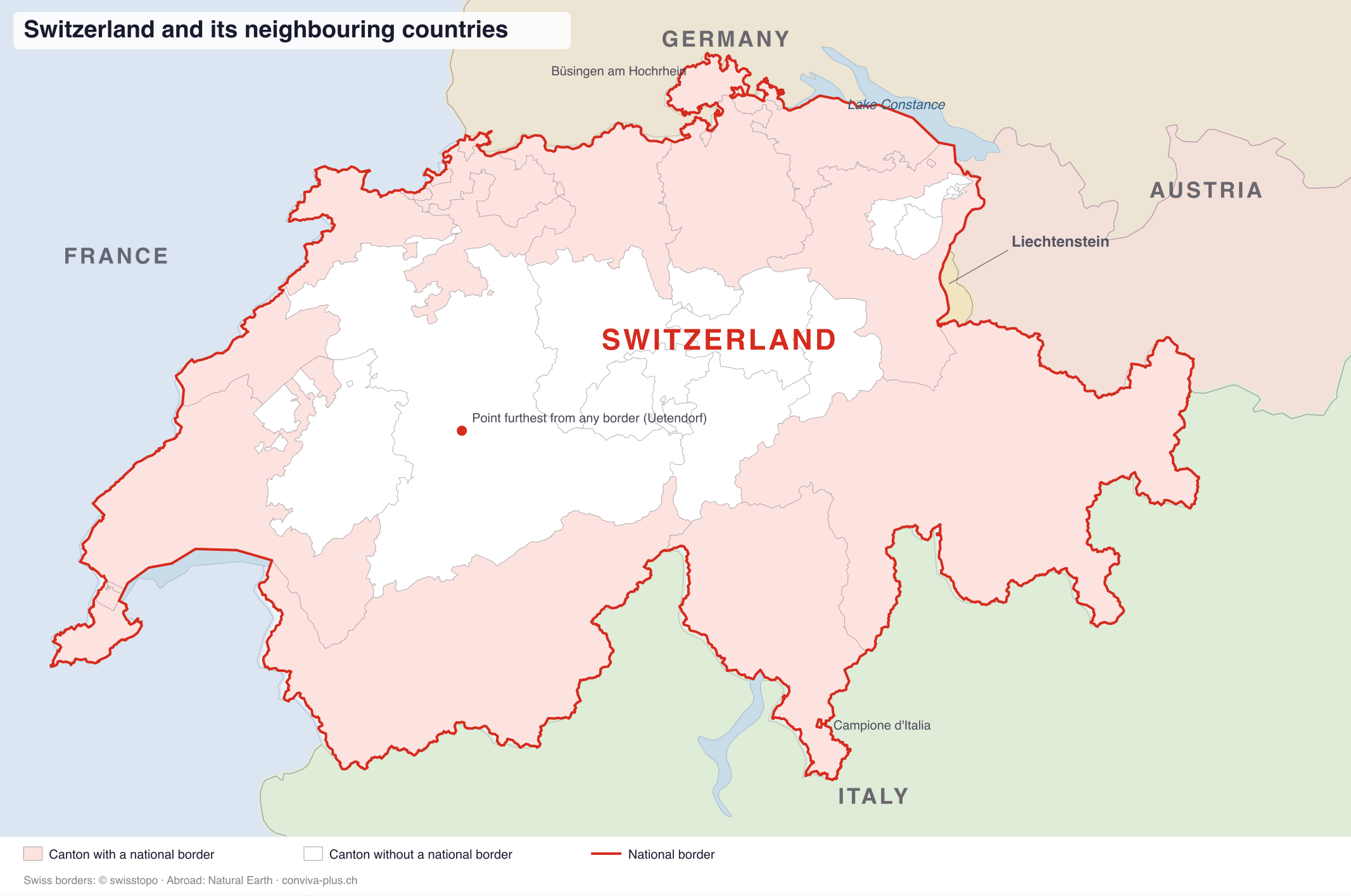
No place in Switzerland is more than about 69 km from a neighbouring country; the furthest is a field near Uetendorf, close to Thun. The border is 1,935 km long, marked by more than 7,000 boundary stones. The longest section is shared with Italy (800.22 km), the shortest with Liechtenstein (41.28 km). And 414,262 foreign cross-border commuters cross it for work.

🗺️ Switzerland neighbouring countries map: which canton borders which country
Bern, the second-largest canton in Switzerland, does not touch a single neighbouring country. It is one of 11 cantons without a national border, like Lucerne, Zug or the two Appenzells.
15 cantons border another country, and only one borders three: Graubünden, next to Italy, Austria and Liechtenstein. The table shows the official border length for each neighbouring country and the cantons it touches. The border cantons come from a ConvivaPlus analysis of swisstopo’s boundary data, not from a textbook: the ConvivaPlus Border Canton Matrix.
| Neighbouring country | Border | Border cantons | included |
|---|---|---|---|
| Italy | 800.22 km | Grisons, Ticino, Valais | Campione enclave |
| France | 585.28 km | Solothurn, Basel-Stadt, Basel-Landschaft, Vaud, Valais, Neuchâtel, Geneva, Jura | – |
| Germany | 363.71 km | Zurich, Basel-Stadt, Basel-Landschaft, Schaffhausen, Aargau, Thurgau | Büsingen enclave, Lake Constance |
| Austria | 180.08 km | St. Gallen, Grisons | Lake Constance |
| Liechtenstein | 41.28 km | St. Gallen, Grisons | – |
📏 Swiss border length: officially 1,935 km, the sections add up to more
Add up the five official border sections and you get 1,970.57 km, 35.6 km more than the official total of 1,935 km.
The reason is in swisstopo’s small print: the section with Germany includes the Büsingen enclave and Lake Constance, the section with Austria Lake Constance too, the section with Italy the Campione d’Italia enclave. A ConvivaPlus analysis of swisstopo’s boundary data shows: the outer border is 1,946.68 km, the edge around Büsingen 17.00 km and the one around Campione 7.19 km. Together that is 1,970.87 km, almost exactly the sum of the five sections.
- 1,970.57 km: swisstopo’s five sections added up, including enclaves and Lake Constance
- 1,970.87 km: ConvivaPlus analysis of swisstopo’s boundary data (outer border plus the edges of the enclaves)
- 1,935 km: the official total length given by swisstopo
- 782 km with Italy and 347 km with Germany: older figures that leave out the enclaves
Anyone quoting “the” border length should say which one they mean. The 1,935 km is the official figure; the sections by country are the more precise answer to how long the border with a given country is. How the border is surveyed and maintained: How long is the Swiss border?
🧭 Cross-border commuters Switzerland: where they come from, canton by canton
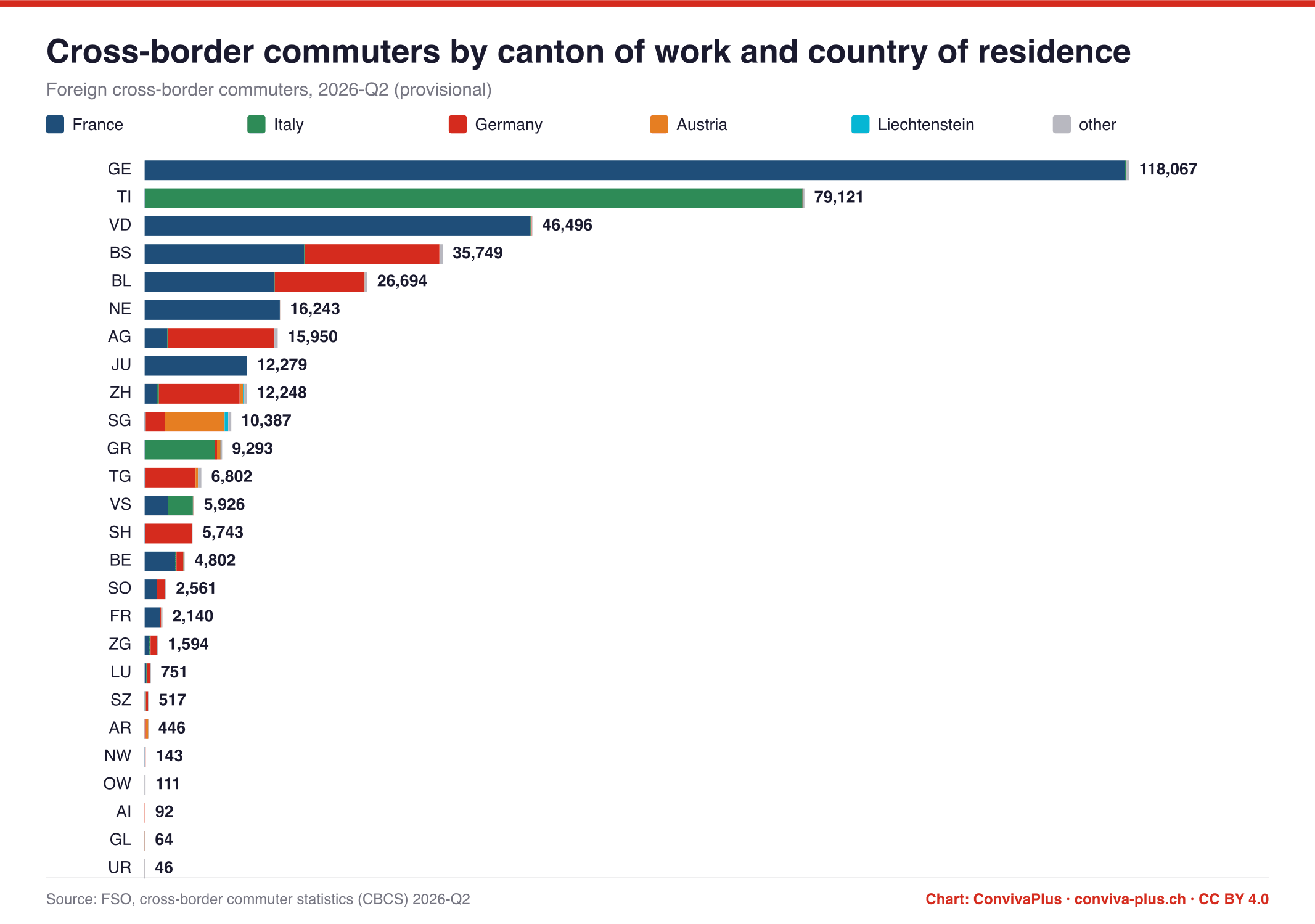
Geneva alone employs 118,067 cross-border commuters, more than come from all of Italy (91,609).
In total, 414,262 foreign cross-border commuters work in Switzerland (Q2 2026), +1.3% on the same quarter a year earlier. Geneva, Ticino and Vaud together employ almost six in ten. Choose your canton and the Cross-border Atlas shows which countries its commuters come from. Or choose a country and see which cantons they commute to.
All 26 cantons and all five neighbouring countries from the Swiss federal cross-border commuter statistics, Q2 2026.
Geneva: 118,067 cross-border commuters, rank 1 of 26.
+3.2% on Q2 2025 · Borders France.
- France117,497 · 99.5%
- other countries341 · 0.3%
- Italy167 · 0.1%
- Germany54 · 0.0%
- Austria8 · 0.0%
Source: FSO cross-border commuter statistics (CBCS), Q2 2026, provisional · foreign cross-border commuters with a G permit by canton of work and country of residence
No guarantee. The data of the Swiss Federal Statistical Office are authoritative.
| Canton | Total | France | Italy | Germany | Austria | Liechtenstein | other | year before |
|---|---|---|---|---|---|---|---|---|
| Geneva | 118,067 | 117,497 | 167 | 54 | 8 | 0 | 341 | +3.2% |
| Ticino | 79,121 | 77 | 78,813 | 56 | 8 | 2 | 165 | −0.6% |
| Vaud | 46,496 | 46,255 | 114 | 47 | 7 | 2 | 71 | +1.9% |
| Basel-Stadt | 35,749 | 19,123 | 64 | 16,150 | 27 | 7 | 378 | −0.1% |
| Basel-Landschaft | 26,694 | 15,578 | 37 | 10,756 | 22 | 7 | 294 | +2.1% |
| Neuchâtel | 16,243 | 16,209 | 11 | 13 | 1 | 0 | 9 | −0.4% |
| Aargau | 15,950 | 2,709 | 103 | 12,685 | 77 | 16 | 360 | +1.5% |
| Jura | 12,279 | 12,261 | 2 | 13 | 0 | 0 | 3 | +3.9% |
| Zurich | 12,248 | 1,455 | 251 | 9,692 | 397 | 150 | 303 | −1.5% |
| St. Gallen | 10,387 | 87 | 44 | 2,295 | 7,168 | 428 | 365 | +1.4% |
| Grisons | 9,293 | 24 | 8,418 | 239 | 422 | 92 | 98 | −5.1% |
| Thurgau | 6,802 | 77 | 29 | 6,003 | 277 | 14 | 402 | −0.2% |
| Valais | 5,926 | 2,819 | 2,962 | 47 | 9 | 1 | 88 | +2.3% |
| Schaffhausen | 5,743 | 35 | 9 | 5,662 | 16 | 3 | 18 | −0.3% |
| Bern | 4,802 | 3,659 | 152 | 822 | 36 | 23 | 110 | +0.2% |
| Solothurn | 2,561 | 1,459 | 43 | 957 | 13 | 4 | 85 | +0.5% |
| Fribourg | 2,140 | 1,856 | 30 | 87 | 6 | 2 | 159 | +15.1% |
| Zug | 1,594 | 553 | 160 | 731 | 50 | 9 | 91 | +5.6% |
| Lucerne | 751 | 202 | 64 | 429 | 23 | 9 | 24 | −0.5% |
| Schwyz | 517 | 80 | 63 | 259 | 24 | 13 | 78 | −1.0% |
| Appenzell Ausserrhoden | 446 | 7 | 5 | 141 | 276 | 6 | 11 | −0.4% |
| Nidwalden | 143 | 34 | 30 | 53 | 12 | 0 | 14 | +5.1% |
| Obwalden | 111 | 14 | 10 | 75 | 4 | 1 | 7 | −2.6% |
| Appenzell Innerrhoden | 92 | 2 | 1 | 32 | 51 | 4 | 2 | −8.0% |
| Glarus | 64 | 7 | 5 | 28 | 8 | 13 | 3 | −11.1% |
| Uri | 46 | 2 | 21 | 21 | 0 | 0 | 2 | +7.0% |
Sorted by total. The FSO extrapolates and rounds the values, so the columns do not always add up exactly to the total.
Method: foreign cross-border commuters with a cross-border permit (G permit), by canton of work and country of residence, FSO CBCS Q2 2026 (provisional), compared with Q2 2025. Swiss citizens living abroad are not counted.
🥖 Switzerland France border: shorter, but the busiest
The border with France is 215 km shorter than the one with Italy. Yet 58.4% of all cross-border commuters come from France, 242,083 people.
The 585.28 km run from the Rhine at Basel across the Jura to Mont Dolent in Valais. In Vaud, Jura, Neuchâtel and Geneva, more than 98% of cross-border commuters come from France. The canton of Geneva employs the most: 118,067, 99.5% of them from France. France has 69.1 million inhabitants (INSEE, 1 January 2026, provisional).
🍝 Switzerland Italy border: the country’s longest
Graubünden is the only canton bordering three countries: Italy, Austria and Liechtenstein. Yet 91% of its cross-border commuters come from just one: Italy.
At 800.22 km, the border with Italy is Switzerland’s longest. It runs through Valais, Ticino and Graubünden and includes the Campione d’Italia enclave on Lake Lugano. In Ticino, 79,121 cross-border commuters work, 99.6% of them from Italy. In total, 91,609 people come from Italy to work in Switzerland.
🥨 Switzerland Germany border: the most populous neighbour, few commuters
With 83,467,117 inhabitants, Germany is the most populous neighbouring country. Yet it sends only 67,350 cross-border commuters, fewer than Ticino alone takes in (79,121).
The 363.71 km with Germany mostly follow the Rhine, from the tri-border point at Basel to Lake Constance, and surround the Büsingen enclave. Where Germany borders, it dominates: in Schaffhausen 99% of commuters come from there, in the canton of Zurich 79%. Basel-Stadt has more cross-border commuters (35,749) than Zurich (12,248), almost half of them from Germany (45%).
⛰️ Switzerland Austria border: three cantons, one majority
In three eastern Swiss cantons, Austrians make up the majority of cross-border commuters: St. Gallen (69%), Appenzell Ausserrhoden (62%) and Appenzell Innerrhoden (55%). The two Appenzells do not even border Austria.
The border with Austria is 180.08 km long, Lake Constance included. It touches only two cantons, St. Gallen and Graubünden. Thurgau also lies on Lake Constance, but on land it borders only Germany. 8,942 cross-border commuters come from Austria.
More than 7,000 boundary stones mark the Swiss border. Many are small historical monuments set from the 16th century onwards, and they are still regularly inspected and maintained.
🏰 Liechtenstein: the neighbour Switzerland commutes to
About 14,900 people living in Switzerland commute to work in Liechtenstein. The other way round, of all working people who live in Liechtenstein only 2,567 work abroad, in all countries combined. Switzerland’s smallest neighbour draws almost six times as many commuters from Switzerland as it sends abroad.
Both figures come from the Liechtenstein Office of Statistics and refer to the end of 2023: 24,641 employees live abroad, 60.4% of them in Switzerland. In the other direction, the Swiss federal statistics count 805 cross-border commuters from Liechtenstein; they only record foreign nationals with a G permit and are therefore not directly comparable. At 41.28 km the border is Switzerland’s shortest and touches St. Gallen and Graubünden. With 160 km² the country is smaller than 25 of the 26 cantons; only Basel-Stadt is smaller.
🏝️ Enclaves Büsingen & Campione: foreign villages inside Switzerland
Two municipalities are completely surrounded by Swiss territory but do not belong to Switzerland: Büsingen am Hochrhein (Germany) and Campione d’Italia (Italy). And they are not even foreign in the same way: Büsingen is part of the Swiss customs territory, Campione has been part of the EU’s since 1 January 2020.
According to a ConvivaPlus analysis of swisstopo’s boundary data, Büsingen covers 7.63 km² with an edge of 17.00 km. Campione lies on the shore of Lake Lugano, with an edge of 7.19 km. There is no customs building at this border. A service office of the Chiasso customs office in Bissone is responsible, with staff present on a targeted basis (FOCBS, as of March 2026).
🌊 Lake Constance border: the line that does not exist
On Lake Constance there is a stretch where nobody can say where Switzerland ends. On the Upper Lake, Switzerland, Germany and Austria have never agreed a border.
swisstopo does not draw a national border there, only a “technical national boundary”, a construction line for its own data. The real border ends in the Bay of Constance and resumes at the mouth of the Old Rhine. On the Lower Lake and the Rhine, by contrast, the border with Germany is fixed by treaty: it follows the middle of the lake and the river.
Which neighbouring country do most cross-border commuters in your canton come from? Guess first, then check in the Atlas.
One click – anonymous, no sign-up required.
❓ Frequently asked questions about Switzerland’s neighbouring countries
Border lengths from swisstopo, cross-border commuters from the FSO (Q2 2026).
People also ask
Related questions from our magazine
1,935 km, marked by more than 7,000 boundary stones. More on the border and how it is surveyed.
Solothurn, Basel-Stadt, Basel-Landschaft, Vaud, Valais, Neuchâtel, Geneva and Jura. Geneva employs the most cross-border commuters from France: 117,497.
Grisons, Ticino and Valais. In Ticino 99.6% of cross-border commuters come from Italy, in Graubünden 91%.
The border verdict
More on Switzerland in figures
Border, cantons and population

ConvivaPlus Editor · Data & Switzerland
Writes about Switzerland in figures – official data recalculated, counting method explained.
- Population
- 26 cantons
- Waterways
- Official data
Free to use with the credit “ConvivaPlus.ch, borders © swisstopo, abroad Natural Earth”.
All information without guarantee. Found an error? → support@conviva-plus.ch
📰 Data and charts for the media
Free to use, including commercially, under CC BY 4.0. Please credit both sources: the primary source and ConvivaPlus. Licence CC BY 4.0
- ⬇ Cross-border commuters by canton (26)cross-border-commuters-by-canton-switzerland.csv · 26 rows
- ⬇ Border length by neighbour (5)border-switzerland-km.csv · 5 rows
Data: FSO, cross-border commuter statistics Q2 2026; swisstopo, national border and swissBOUNDARIES3D · Processing: ConvivaPlus, «Countries bordering Switzerland 2026: all 5 with map», https://www.conviva-plus.ch/en?page=2847 (Data as of 16 October 2026), CC BY 4.0
Questions, an analysis for your canton or the raw data? support@conviva-plus.ch
Found an error or have feedback? Let us know or write to us directly.